Sunday, September 8, 2013
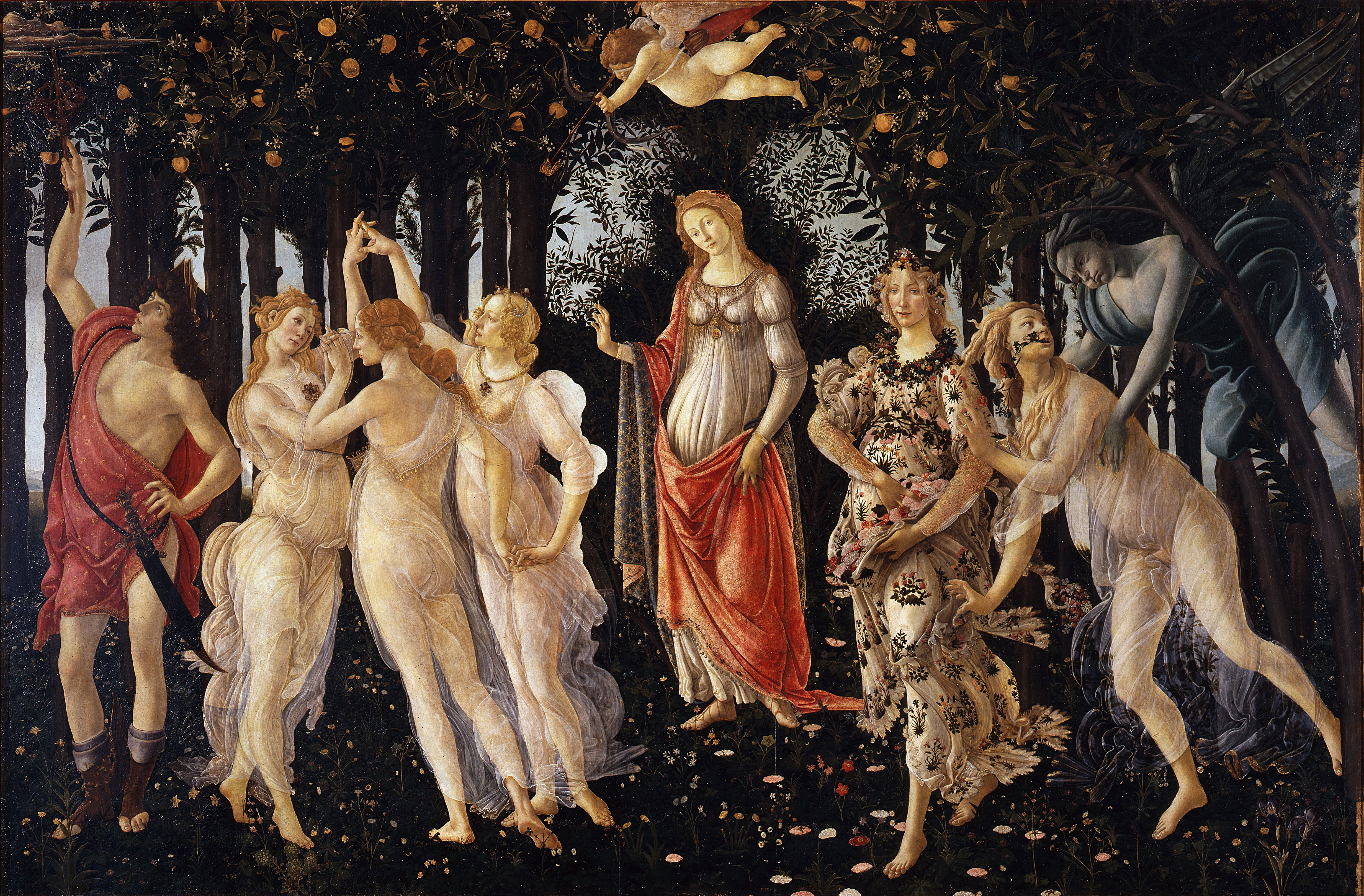
ART SUNDAY--SANDRO BOTTICELLI--
HI ALL HOPE EVERYONE IS HAVING A WONDERFUL SUNDAY AND YOUR WEATHER IS GREAT TODAY I DO ONE OF MY MOST FAVORITE MASTERS ENJOY
Alessandro di Mariano di Vanni Filipepi , better known as Sandro Botticelli (Italian: [ˈsandro bottiˈtʃɛlli] ; c. 1445[ 1] – May 17, 1510), was an Italian painter of the Early Renaissance . He belonged to the Florentine school under the patronage of Lorenzo de' Medici , a movement that Giorgio Vasari would characterize less than a hundred years later as a "golden age ", a thought, suitably enough, he expressed at the head of his Vita
of Botticelli. Botticelli's posthumous reputation suffered until the
late 19th century; since then his work has been seen to represent the
linear grace of Early Renaissance painting. Among his best known works
are The Birth of Venus and Primavera .

| Sandro Botticelli | |
|---|---|
Probable self-portrait of Botticelli, in his Adoration of the Magi (1475).
| |
| Birth name | Alessandro di Mariano di Vanni Filipepi |
| Born | c. 1445[ 1] Florence , Republic of Florence , (now Italy ) |
| Died | May 17, 1510 (aged 64–65) Florence , Republic of Florence , (now Italy ) |
| Nationality | Italian |
| Field | Painting |
| Training | Filippo Lippi Andrea del Verrocchio |
| Movement | Italian Renaissance |
| Works | Primavera The Birth of Venus The Adoration of the Magi Other Works |
SELF PORTRAITS
Sunday, August 25, 2013
ART SUNDAY--MAX SLEVGOT
MAX SLEVGOT
He was born in Landshut , Germany. From 1885 to 1889 he studied at the Munich Academy, and his early paintings are dark in tone, exemplifying the prevailing style in Munich. In 1889 Slevogt visited Paris , where he attended the Académie Julian . In 1896, he drew caricatures for the magazines Simplicissimus and Jugend , and the next year he had his first solo exhibition in Vienna .
Toward the end of the 1890s his palette brightened. He travelled again to Paris in 1900, where he was represented in the German pavilion of the world exhibition with the work Scheherezade , and was greatly impressed by the paintings of Édouard Manet . In 1901 he joined the Berlin Secession .
A trip to Egypt in 1914 resulted in 21 paintings as well as numerous watercolors and drawings; on the return journey he stopped off in Italy . In June he acquired the country seat Neukastel. After the outbreak of World War I he was sent as official war painter to the western front. The war experience brought about a search for new style appropriate to the expression of the horrors of war. In the same year he became a member of the royal academy of the arts in Berlin.
He designed scenery for the performance of Mozart 's Don Giovanni in the Dresdner state opera in 1924. In 1929 he was given a large 60th birthday exhibition in the Prussian academy of the arts in Berlin. During the last year of his life he worked on the religious mural Golgatha in the peace church in Ludwigshafen on the Rhine. It was destroyed by bombing raids during World War II .
Max Slevogt died in Leinsweiler (at that time in the Rheinpfalz part of Bavaria ) in 1932. He is buried in the burial place of the family Finkler east of his house, the so called Slevogthof (with wall paintings) at Neukastel.
Sunday, August 18, 2013
Monday, August 12, 2013
Sunday, July 14, 2013
Subscribe to:
Posts (Atom)